



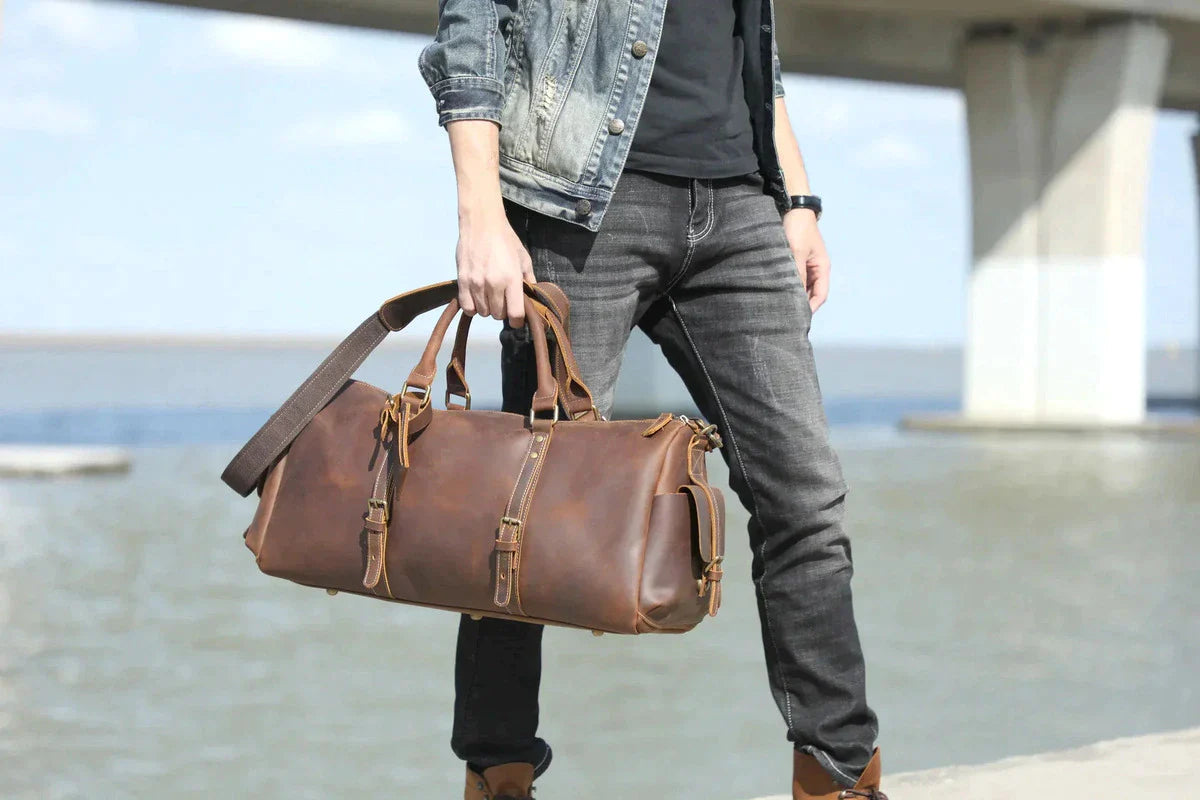


Leather Duffle Bags for the Two-Night Life
Friday, six o'clock. The bag lands on the passenger seat: one zip, two shirts, a wash kit, the book you will not read. Twenty minutes from now it will be under a train seat, and it was built with that in mind. No suitcase rattling behind you on the platform, no waiting at a carousel. The duffle rule is old and simple: if it does not fit in one bag, it stays home. A duffle is the luggage of someone who has packed enough times to know what they actually use. A leather one says you plan to keep doing it for twenty years.
Every bag here is full grain cowhide, most of it crazy horse, oiled and waxed. The line runs from a 20-litre overnighter to a 52-litre hauler, and empty weights sit between 1.3 and 2.4 kg: that is the honest cost of leather, and if you would rather carry half of it, our canvas duffle bags do the same job lighter. The other honest line: a duffle has no wheels and no shell. If you fly weekly with a suit that must arrive pressed, this is not your bag.
Pick the Litres First
With duffles, everything else is taste; the litre count is the decision. Below, the collection sorted the way you will actually use it, with the bag we would hand you first in each case. Start from the nights you actually pack for. Imaginary long trips have sold more oversized bags than any salesman.
One night, packed light
Twenty to 23 litres holds a change of clothes, a wash kit and a charger, rolled, with room to bring something back. The GUAYAQUIL (20 L) is the lightest bag of the line at 1.3 kg empty; the MERIDA (23 L, 1.45 kg) is the black version of the same idea, and the least expensive way into the collection. The trade-off at this size: it will not absorb an unplanned third night. That constraint is also the pleasure of it: a bag this small packs itself in four minutes, and unpacking is turning it upside down over the bed.
The classic weekender
Twenty-seven to 35 litres is the weekend format, the reason "weekender" became a word of its own. The RIO (35 L, 1.8 kg) is the archetype: two nights of clothes, shoes packed flat at one end, and it still goes soft-sided into an overhead rack. Coming by train with work in tow, the PANAMA (34 L, 2.2 kg) adds a padded sleeve that takes laptops up to 17 inches.
Laptop days, travel nights
The CARACAS (26 L, 2.2 kg) is the crossover: crazy horse hide, a 15-inch laptop compartment, and a footprint that works as an everyday office bag on Monday and an overnighter on Friday. One bag doing two jobs is the whole argument for it, and the compromise is real too: it is neither the biggest weekender nor the lightest briefcase. If your calendar has more Mondays than Fridays in it, start here.
The long haul
Past 40 litres, a duffle stops being a weekend bag and becomes kit transport: a week away, sports gear, the family overflow. The SANTIAGO (52 L, 2.4 kg) is the biggest hide in the shop, and at full load it will test your shoulder. Load it heavy and you will want the strap padded and short; load it often and you may want a leather backpack instead, because two straps carry a week better than one.
If you hesitate between two sizes, pack for the nights you actually booked, and add nothing: the duffle you fill is the duffle that keeps its shape. The one you buy "in case" sags in a cupboard. And if two sizes still feel possible after counting, take the smaller: a duffle carried nine tenths full looks intentional; half empty, it folds on itself.
Built for the Way a Duffle Gets Treated
Nobody babies a duffle. It gets swung, dropped at gates, wedged under train seats, carried by one handle when both would be wiser. So the construction is where the money goes: double leather handles, reinforced stitching at the points where a packed load pulls, an adjustable shoulder strap for the walks that turn out longer than planned. Zips are the part that kills cheap travel bags; these run the full mouth of the bag, so you load it flat like a case instead of feeding it through a slot, and you see everything you packed.
The hide itself is full grain, the outermost layer with the grain intact, and on most models it is crazy horse: oil-soaked, wax-sealed, the finish that shifts colour where it bends and darkens where it is handled. A duffle picks up its patina faster than any other bag we make, simply because it lives on floors, racks and shoulders. What that finish is, why it scars and heals, and how to read it is on our crazy horse leather guide: worth five minutes before you choose a colour, because the tan hides age louder than the dark ones.
When the bag arrives, do the once-over that matters: run the main zip end to end with the bag empty, lift it loaded and check the handles sit even in your hand, and expect the colour to sit a shade away from the product photos. Crazy horse hides never drink the oil identically, which is why two copies of the same model stop being copies within a season. If anything in that once-over disappoints, that is what the 30 days are for.
20 to 52 Litres, Translated Into Nights
Twenty litres is one night, packed by someone who rolls their clothes. Add a rail journey and a paperback, nothing changes. Twenty-seven litres is two nights with a spare pair of shoes. Thirty-five litres is the full weekend plus a laptop and the freedom to pack badly. Fifty-two litres, the SANTIAGO, is a week away, or one person's share of a family car boot. An overhead train rack takes the SANTIAGO; a budget-airline sizer will not. A leather duffle bag does not expand and does not forgive a suitcase-packer's habits: measure your usual trip against those anchors, then buy the size below the one you were about to choose.
Why Buy It Here
We have shipped more than 25,000 orders, and what buyers say about them is on Trustpilot and our own reviews page, unedited. The practical part: standard shipping is free worldwide, everything leaves our warehouse in France, every bag is covered for 2 years against the failures that matter (seams, handles, zips), and you have 30 days to bring it back if the size was wrong. If something gives inside the warranty, we repair it or replace it, and we would rather repair: a fixed bag keeps its patina. A duffle bought in the wrong litre count is just a returns label away from the right one.
FAQ
Duffle, holdall, weekender: what is the difference?
Mostly the accent. "Duffle" (or duffel) is the general term, "holdall" is the same bag in British English, and "weekender" describes a size class around 28 to 40 litres rather than a different design. Our model names use all three; the shape, a soft body with a full-length zip and twin handles, is the same family throughout.
Will a leather duffle bag pass as cabin luggage?
Usually up to around 35 litres, but the honest answer is: check your airline, not the marketing. Soft bags compress into sizers in a way hard cases cannot, which helps at the gate. Every product page lists exact dimensions in centimetres and inches: compare them against your carrier's limits before you fly, especially on low-cost routes.
How heavy is a leather duffle empty?
Between 1.3 and 2.4 kg across this collection, and each product page states the exact figure. That is two to three times a technical nylon duffel, and no honest seller will tell you otherwise. You are trading grams for a bag that gets better instead of shabbier; if the grams matter more, waxed canvas is the middle ground.
Is this real full grain leather?
Yes: full grain cowhide, the top layer of the hide with the grain intact. The confusing industry term "genuine leather" actually names a lower grade built from split layers under a coating; the difference matters more on a travel bag than anywhere else, because handles and straps fail first on split leathers. The full grading breakdown is in our genuine leather guide.
Can a leather duffle handle rain?
Rain on the way to the car, yes. A wet afternoon on a luggage rack, also yes. Sitting in standing water, no: the oil and wax shed showers but leather is not a dry bag, and anything electronic inside deserves its own sleeve in bad weather. The details are in our guide to whether leather is waterproof.
How should I store it between trips?
Stuffed with paper or a towel so the panels keep their shape, zips closed, somewhere ventilated and away from direct heat. Leather that sits empty for a season can dry out; if yours has, our guide on how to rehydrate leather brings it back in one evening with the right oil.
Do these bags work for women too?
Yes. The cuts are unisex; what changes with the wearer is the sensible size. Loaded, a 52-litre duffle is a genuine carry regardless of who lifts it, so the practical advice is the same for everyone: pick the size your trips and your shoulder can defend, and remember that the smaller formats ride better worn across the body.
Which of these duffles take a laptop?
Four of them, each with a padded sleeve: the PANAMA and the MEDELLÍN take machines up to 17 inches, the CARACAS and the ASUNCION up to 15. In the others a laptop travels loose, which is fine on a car seat and a bad idea anywhere a bag gets stacked. Exact sleeve dimensions are on each product page.
Before You Pack
Three reads that answer the next questions buyers ask us. Our weekender and overnight bag guide goes deeper on matching bag formats to trip lengths, with the honest maths on what a weekend actually weighs. The holdall guide covers the British side of the family, from army kit bag to platform classic, and how these bags earned their name. And how to pack light for two weeks is the article that turns a 35-litre bag into enough. When the leather needs feeding after a hard season, the best oils for leather guide covers what to use on waxed hides. Then stop reading, pick your litres, and go somewhere that scuffs the corners a little. That is what the bag is for.