



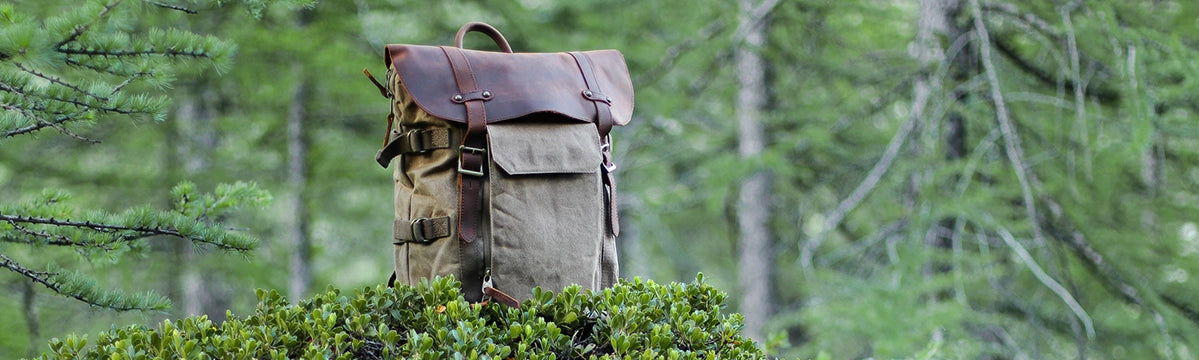


Camera Backpacks That Keep the Secret
Set the bag down at a café table, lift out the body, change a lens, and the table next to you registers nothing. That is the quiet argument for a camera backpack that looks like luggage instead of equipment: the black technical rig announces what it carries to everyone who knows what three thousand euros of glass looks like. Waxed canvas and leather announce a holiday. The camera stays a rumour until you choose to confirm it.
Underneath the vintage cut, these are camera bags in full: padded dividers to wall off bodies and lenses, tripod straps, quick access on most models. Twelve packs and bags, 13 to 28 litres, 0.8 to 1.9 kg, every one named after a national park it would not embarrass. Two honest exits first. If your kit flies checked or runs past four lenses, a hard technical case protects better than any soft bag, ours included. And if you carry a camera only sometimes, our canvas backpacks plus a padded pouch may be all you need.
Which Bag for Which Photographer
Sort by how you actually shoot; the size of the cupboard at home is a different question. The collection breaks into four ways of carrying a camera, plus one honest question about the rest of your gear.
Street and city days
Small, fast, worn close. A camera you cannot reach in five seconds is a camera that misses the picture, and city bags are built around that clock. The FUJI (15.5 L, 0.8 kg) is the sling: it swings from back to chest without coming off, which is the whole point of a sling when the light is moving. The VILNIUS (13 L) is the shoulder version, a camera bag that passes for a satchel in any archive, library or bar, which is exactly where shoulder bags out-shoot backpacks: nothing to take off, nothing to unpack.
The everyday camera backpack
The KRUGER (22.5 L, 1.4 kg) is the centre of the range: padded camera bay below, daily life above, tripod straps outside. The HALIBURTON (20 L, 1.3 kg) runs the same brief a size tighter, with more leather in the mix. Both carry a body, two or three lenses and the non-camera half of your day without dressing you as a press pool. If you only buy one bag from this page, it is probably one of these two.
Hiking and weather
Rain is the real enemy of a camera day out; cold just changes the batteries, water ends the session. The ALGONQUIN (25 L, 1.3 kg) wears the waxed finish that beads water; the YELLOWSTONE (25 L, 1.2 kg) is the one built specifically to be rained on. For long days with layers, food and a full kit, the JOTUNHEIMEN (28 L, 1.9 kg) is the largest camera pack we make. All three keep the glass walled off from whatever the mountain adds, and the tripod rides outside on its straps instead of eating the compartment.
The leather one
The DENALI (17.5 L, 1.4 kg) is the answer when the camera is part of how you dress: waxed canvas dressed in crazy horse leather, dividers inside, and a finish that only improves with a decade of scuffs. It costs weight against the canvas models, and it earns it back every time someone asks where the bag is from instead of what is in it. Ten years from now it will be the best-looking thing in your kit, camera included.
Still choosing? Count lenses, not litres: a body and two lenses fit everything here. Past three lenses plus a drone, only the 25-litre-and-up formats stay comfortable, and past five you have outgrown soft bags altogether. Most people who think they need the biggest bag shoot ninety percent of their frames with the same body and the same lens; buy for the ninety percent.
Protection, Without the Costume
The camera compartments here do what the technical brands do: padded dividers that reposition to fit a mirrorless kit or a gripped DSLR, walls between glass and the outside world, soft lining where the gear sits. What they refuse is the costume: no logo panels, no all-black ballistic shell, no modular webbing telling a train carriage what you own. The outer fabric is the same waxed cotton and full grain leather as the rest of the shop, which means the bag ages into a travel object instead of wearing out like a gadget.
The names are a small tell of their own: all twelve bags are named after national parks, HALIBURTON to SERENGETI, because that is the postcard rack they were sketched from. The movable dividers are also what lets one bag change jobs mid-trip: full camera layout on the shooting days, one padded corner and a jumper on the others. Most owners end up somewhere in between, with the kit walled into the bottom third and the day piled on top, which is precisely the layout a stumble punishes least.
Two honest limits, stated plainly. A soft bag protects against knocks, rain and abrasion, and it does not protect against a car parking on it: hard cases exist for a reason, and that reason is airline holds. And the vintage look buys discretion, never invulnerability: it lowers the odds of being marked as a camera carrier, and changes nothing about where you set the bag down. The materials story is in our canvas and waxed canvas guide; what the weather can and cannot do to them is in are canvas bags waterproof.
13 to 28 Litres, in Camera Terms
Thirteen to 15 litres, the VILNIUS and FUJI, is a body, two lenses and a jacket: the walking-around kit. Twenty to 22 litres adds the day around the camera: food, layer, notebook. Twenty-five litres, the ALGONQUIN, YELLOWSTONE and SEQUOIA (25 L, with its removable insert), is the full-kit day plus weather cover; pull the SEQUOIA's insert out and it is a plain travel backpack for the days the camera stays home. Twenty-eight, the JOTUNHEIMEN, is kit plus mountain, the format where the camera is one passenger among several. A camera backpack filled past its dividers stops protecting anything, so if you are between sizes, take the larger one for once: empty padding beats crushed glass.
The Part We Sign
More than 25,000 orders out the door and the reviews are public, on Trustpilot and our reviews page. Free standard delivery worldwide, shipped from France, 2 years of warranty on seams, straps and hardware, repaired or replaced, and 30 days to change your mind: cameras are picky about their houses, so try the fit with your actual kit, dividers set the way you would really use them. Prices live in the grid above. And if the bag is a gift for the photographer in your life, size generously: nobody has ever returned litres for being too many, and the dividers close the gap in the meantime.
FAQ
Do vintage camera backpacks actually protect a camera?
Yes, by the same means the technical bags use: padded, repositionable dividers, lined compartments and walls between the glass and the world. The difference is the outside, which is cotton and leather instead of coated nylon. What no soft bag does, ours included, is survive crushing: for airline holds and brutal transits, use a hard case.
How many lenses fit?
A body plus two lenses fits everything in the collection. The 22-to-25-litre packs take a third lens or a drone alongside; the JOTUNHEIMEN takes the full kit plus a mountain day. Divider layouts move, so the honest measure is your own kit against the internal dimensions on each product page.
Is a camera sling better than a backpack?
For shooting, often yes: the FUJI swings from back to chest without being taken off, which keeps the camera in your hands when the light is changing. For carrying, a backpack wins from the second hour onward. The split most photographers land on: sling for the city, backpack for everything longer.
What happens if it rains on my camera bag?
On the waxed and waterproof models, the water beads and rolls while the dividers keep the kit away from the wet outer layer; the ALGONQUIN and YELLOWSTONE are the two we would take into real weather. No soft bag is a dive housing, so in a monsoon the camera goes inside a dry pouch, bag or no bag.
Can I use one as a normal backpack?
Yes, and that is half the argument for them. The dividers reposition or come out entirely, the SEQUOIA's insert lifts out in one piece, and what remains is a vintage canvas pack with no trace of its second job. A technical camera bag never stops being one; these do.
Does a vintage bag make my gear safer from theft?
Safer is the wrong word; less advertised is the right one. A recognisable camera bag tells a practised eye exactly what is inside, and a waxed canvas pack does not. That lowers your profile in stations and tourist crowds. It replaces none of the usual sense: the bag stays on your front in a crowd, whatever it looks like.
Do they fit mirrorless kits or only DSLRs?
Both: the dividers reposition, so a compact mirrorless kit simply gets tighter walls and more room left over for the day. If you shoot a small body with one lens, the VILNIUS or the FUJI already count as generous. The DSLR sizing in some product names dates from the era, and the compartments never cared.
Which one for hiking with a camera?
The YELLOWSTONE if weather is the worry, the ALGONQUIN if you want the wax patina, the JOTUNHEIMEN if the day includes layers, food and a tripod. All three carry the kit walled off low, where a stumble hurts it least. For summit days where every gram counts, decant into a padded pouch inside a technical pack instead.
One More Frame Before You Go
If you are weighing fabrics, our canvas vs leather guide settles the trade-offs in five minutes, and how to clean canvas is the maintenance routine for when a shoot ends in mud. There is also a one-shoulder answer to all of this: the WASHINGTON camera messenger carries a body and two lenses at hip height, from our canvas messenger bags. Whichever you pick, the best camera bag is the one that gets you to take the camera at all: choose the one you will grab on the days you almost do not. Those are the days the photographs come from.