



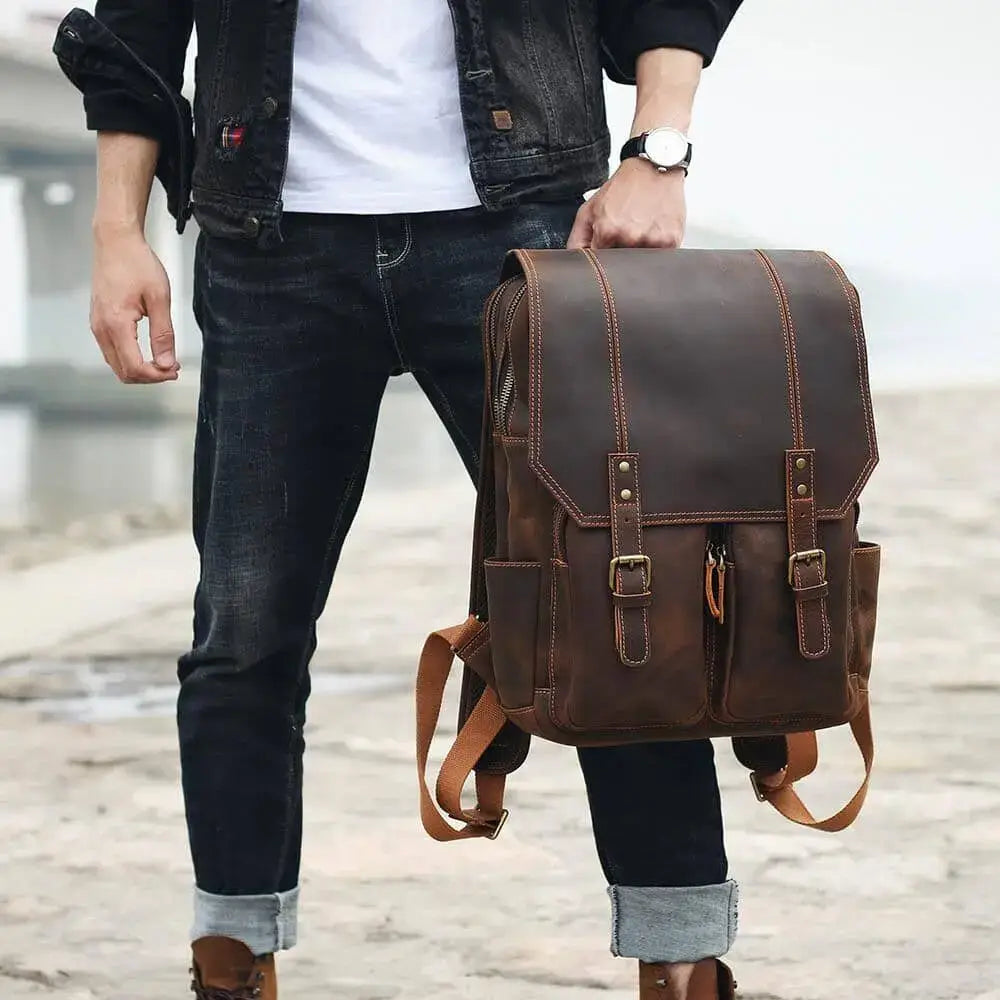


Leather Backpacks That Earn Their Marks
The first scratch turns up within a week. A door frame, the buckle of a train seat, the corner of a desk you have walked past a thousand times. On most leather that would be damage. On crazy horse it is the mechanism: press a thumb over the mark, the wax warms, and the line sinks back into the grain as a shade rather than a scar. Give it a year and the bag carries a record of where it has been that no factory finish can imitate.
Every bag in this collection is cut from crazy horse: full grain cowhide soaked in oils and finished in wax, the top layer of the hide with the grain left intact. Call them rucksacks or backpacks, we use both words for the same thing. The range runs from a 10-litre city pack to a 25-litre travel format; the grid above keeps the prices current. One honest warning before you scroll: leather costs weight. These bags weigh 1.1 to 1.9 kg empty, and if you count grams for long trails, our vintage canvas backpacks will serve you better. Leather is for carrying less, longer.
Which One Fits How You Carry
Ignore the model names for a minute and start from what is on your back on a normal Tuesday. The collection splits into four ways of carrying, and the right bag sits in one of them.
A laptop and the office, every day
For a laptop carried daily, a leather rucksack with its own compartment beats a sleeve thrown into a bigger bag: the machine rides flat against your back and the hide absorbs the knocks. The ROSKA (16 L, 1.6 kg) splits into two compartments, kit on one side, laptop and papers on the other. If you want smaller and black, the WALTER (12 L, 1.1 kg) takes machines up to 13 inches and passes unnoticed in any meeting. The trade-off of structured compartments: great order, no give. Don't expect one to swallow the Friday grocery run.
One to two nights away
For a weekend, 25 litres is the ceiling before a backpack stops being a backpack. The WATERLOO (25 L) is the travel format of the collection: dedicated laptop sleeve, a front pocket under magnetic clips for the things you pull out at security, side pockets for the rest. It swallows two days of clothes, boards as a carry-on, and still closes clean. Past three nights, stop forcing it: a leather duffle carries the volume and spares your shoulders.
Light days in town
Between 10 and 14 litres, a bag carries a jacket, a book and lunch without the half-empty slouch of an oversized pack. The ALBA (10 L, 1.3 kg) is the compact cut of the range, and the one that ages fastest into its patina, because it goes everywhere: the bakery run, the library, the last train home. The DASHAN (14 L) closes with a drawstring under a flap and is lined in cotton denim. A drawstring is slower than a zip. If you are in and out of your bag all day, pick a zip model instead.
Cut for smaller frames
A full-size pack on narrow shoulders looks and feels like borrowed luggage. The AYA (20 L, 1.5 kg) keeps the full capacity in a narrower cut, lined in cotton canvas, with a hidden pocket against the back panel for passport and phone. Same hide, same hardware, same volume, in a cut that actually fits a smaller back.
Still hesitating between two sizes? Choose for the heaviest day of your normal week, not for the trip you take twice a year. The litres you carry every day matter more than the litres you might need someday.
Crazy Horse Leather, and Why It Scratches on Purpose
Full grain means the top layer of the hide, grain intact, nothing sanded away. It is the strongest cut of leather and the only one that builds a true patina. After tanning, the hide is immersed in oils, then sealed under a coat of wax. That wax is what you see moving: bend the leather and the colour lightens across the fold, scratch it and the mark shows pale before it feeds back into the grain. Rub it with a thumb or a soft dry cloth and watch it happen: the full story of the process is in our crazy horse leather guide.
No two hides take the oil the same way. Expect variation between the bag on your screen and the bag on your doorstep, shade to shade rather than colour to colour. That variance is the fastest proof you are holding leather and not a printed film. Inside, the linings change with the model: cotton canvas on some, denim or polyester on others, each listed on its product page. The stitching is the part you should inspect when the bag arrives: seams doubled where the straps pull, because that is where a decade of carrying concentrates.
Patina is friction plus time, nothing more mystical than that. The wax thins first where your hands land: the top handle, the edge of the strap you always grab with the same fingers, the corner that meets the floor under every café table. Those zones darken and soften while the rest of the panel keeps its early tone, and the contrast is what people mean when they say a bag has character. You cannot buy it finished and you cannot rush it. Two bags from the same hide, carried by two different people for a year, come back looking like they were never related. That is the part of the price no factory can fake.
Black, brown or tan? The dark hides mute the patina and read formal; tan shows every mark first and loudest; coffee and brown split the difference. If you want the diary, go light. If you want it discreet, go dark.
From 10 to 25 Litres: What That Means in Real Life
Litres are abstract until you pack them. Ten litres, the ALBA, is a jacket, a paperback and a water bottle: the errand bag. Twelve litres with a 13-inch laptop, the WALTER, is the office minimum. Sixteen litres, the ROSKA, adds gym kit or a lunch that is not a sandwich. Twenty litres, the AYA, is a laptop plus a change of clothes: the overnight-if-you-have-to size. Twenty-five litres, the WATERLOO, is two nights away in a single bag. A leather backpack holds its shape as it fills; measure your usual load against these anchors and land on the litre count before you fall for a silhouette. And if you still hesitate between two models, count something concrete: between the WALTER and the ROSKA, count your cables. Between the AYA and the WATERLOO, count your nights.
Why Buy From Eiken
More than 25,000 orders shipped, and the reviews are public: read them on Trustpilot or on our reviews page before you trust a word of ours. Standard shipping is free worldwide, every bag ships from France with a 2-year warranty, and you have 30 days to change your mind once it is on your shoulders. If a strap, a seam or a buckle lets you down inside that window, we fix it or replace it. That is the whole pitch.
FAQ
Is crazy horse real full grain leather?
Yes. Crazy horse is full grain cowhide, the top layer of the hide with the grain intact, immersed in oils and finished with wax after tanning. It is not a coated split or a printed film. The quickest proof is the wax itself: bend or scratch the surface and the colour shifts, then feeds back into the grain.
Will scratches ruin the bag?
No, scratches are how this leather is meant to age. A pale mark appears, you rub it with a thumb or a soft cloth, and it blends into the patina. But be honest with yourself: if you want leather that stays showroom-uniform for years, crazy horse is the wrong choice, and a smooth finished leather will make you happier.
Are leather backpacks waterproof?
Leather handles rain and loses to standing water. The oil and wax shed showers, a wet commute, snow brushed off at the door; none of it survives a soak, and no leather bag should be trusted with a laptop in a downpour. We wrote the honest breakdown in whether leather is waterproof, including what the wax actually does.
How much care does the leather actually need?
About ten minutes a year. Wipe it with a barely damp cloth when it is dirty, condition it once or twice a year to feed the oils back in, and keep it away from radiators and the parcel shelf of a car in July. Our guide to the best oils for leather covers what to use and what to keep away from wax finishes.
What laptop sizes fit these backpacks?
It depends on the model. The WALTER takes machines up to 13 inches; the larger packs take more. Every product page lists internal dimensions in centimetres and inches: measure your laptop and check it against the bag before ordering, especially if you carry a 16-inch machine in a hard case.
How heavy is a leather backpack?
Between 1.1 and 1.9 kg empty across this collection, and each product page states the exact figure. Leather is denser than canvas, and no treatment changes that. If your priority is the lightest possible carry, a waxed canvas pack does the same job at roughly half the weight.
What is the difference between full grain and genuine leather?
Full grain is the top of the hide with the grain intact, the strongest and longest-living grade. "Genuine leather", despite the reassuring name, is an industry term for lower-grade layers bonded and refinished. Every backpack here is full grain. The full grading breakdown is in our guide to genuine leather.
Are these backpacks for men or for women?
Both. The collection is mixed and most cuts are unisex; what actually differs between models is width and strap reach. The AYA and the smaller packs sit better on narrow shoulders, while the 23 to 25 litre formats assume a longer back. Ignore the label, read the dimensions on the product page, and match them to your frame.
Read Before You Commit
The leather guide is where this shop started, and three of its articles answer the questions buyers send us most. How to restore leather walks through bringing a neglected bag back, step by step, including when to stop. How to soften leather covers the break-in period, and what actually speeds it up without damaging the wax. How to rehydrate leather is the one to bookmark for the end of a dry summer, when the hide starts asking for oil. And if most of your carrying happens on one shoulder between meetings, the leather messenger bags do the same job at hip height. Either way, the hide keeps the record of where you took it. That is what you are buying.