



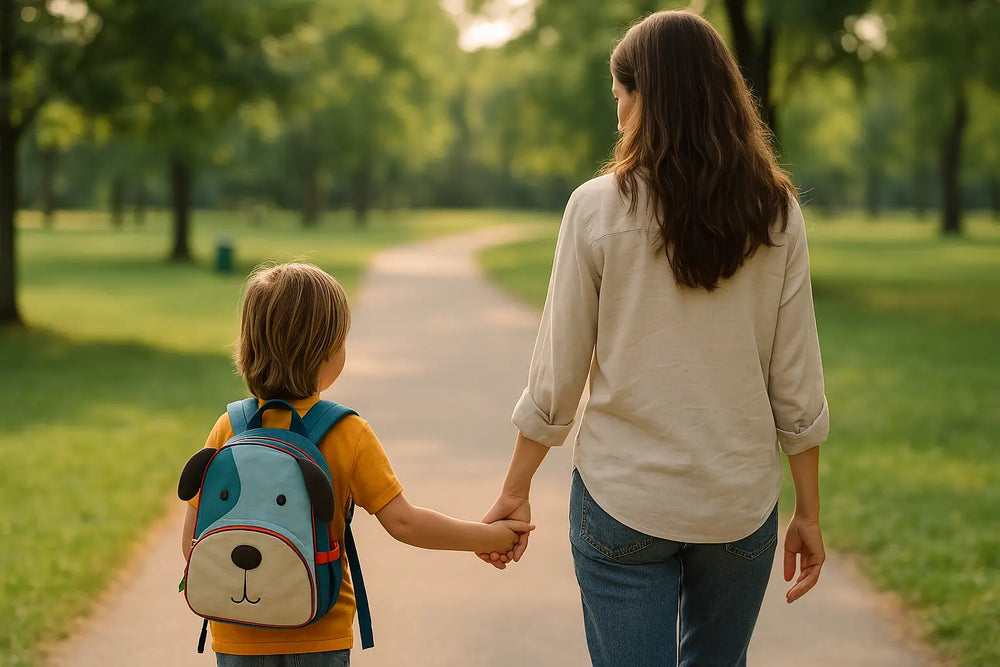
Kids' Backpacks: What Size to Choose by Age (5-12)
Reading Time: about
School morning: your kid hoists the bag with both hands, swings it onto one shoulder, then the other, and bolts for the gate. The next weekend, that same bag follows them up a trail, water bottle in the side pocket and a squashed snack at the bottom. That is what a child's first real backpack is: an object that lives the playground as much as the woods, and has to hold up on both.
A good kids' backpack comes down to two things, not the print on the front: fit and load. Aim for a volume that matches the age (around 10-14 L at 5-7, 16-20 L at 8-12) and never let the loaded pack exceed 10 to 15 % of the child's body weight. Everything else - padded straps, a sternum strap, a short fitted back panel - exists to keep the weight where it belongs, on the lower back and hips, never pulling backward.
This guide is for parents of children aged 5 to 12 looking for a backpack for school and the outdoors. If your child is under 4 (daycare, preschool, harness packs), you are on the wrong guide: little ones need something else. And if you want a rigid satchel to haul ten textbooks all year, look to the school-bag specialists instead. Here, we are talking about bags that move.
At What Age Can a Child Carry a Backpack?
As soon as they walk well and want to carry their own things, a child can wear a small pack. At 2-3, it is a game: a soft toy, a snack, nothing more. But the first bag that really earns its place, the one that goes with big school and the first proper walks, tends to arrive around 5-6. That is the age when a child stays on their feet for half a day, understands they are responsible for what they carry, and starts wanting to choose what goes in.
One rule outranks everything else, from the American Academy of Pediatrics: a loaded pack should never exceed 10 to 15 % of the child's body weight. A 25 kg child carries 2.5 to 3.7 kg at most, water and snack included. Beyond that, they compensate by leaning the torso forward, and that is where the tension in the shoulders and lower back begins. A kitchen scale under the full bag settles the question in ten seconds.
Volume by Age: The Reference Table
Volume is the most common trap. Too big, and the child fills it to the top and ends up overloaded; too small, and you replace it in six months. These are not hard rules - a tall child moves up a size sooner - but they frame the right ballpark.
| Age | Recommended volume | Max loaded weight | Typical use |
|---|---|---|---|
| 3-4 yrs | 4-8 L | ~1 kg | Soft toy, snack, short walk |
| 5-7 yrs | 10-14 L | 1.5-2.5 kg | School, day outing |
| 8-12 yrs | 16-20 L | 2.5-4 kg | School, hiking, weekend |
| 12+ yrs | 22-26 L | 4 kg and up | Real hiking, travel |
For reference: the Patagonia Refugito 12L lands right on the 5-7 range, and the Refugito 18L covers 8-12 without swamping them. The latter weighs 515 g empty, which leaves the whole 10-15 % margin for the contents, not for the bag itself.
The Criteria That Actually Matter
1. Fit above all
A child's pack is not a scaled-down adult pack. What changes everything is the back length: a short back panel, built for small shoulders, keeps the load high and close to the body. Look for padded, adjustable shoulder straps and, above all, a sternum strap. That little strap clipped across the chest stops the straps sliding off when the child runs, and shifts part of the load onto the torso instead of letting it all pull on the shoulders. It is the detail that separates a bag that stays put from a bag that flops around.
2. Empty weight
Every gram of empty bag is a gram less for the contents, inside an already tight 10-15 % window. Light recycled polyester fabrics do the job: tough, water-repellent, and far lighter than leather or heavy rigid canvas. For a child, light is not a luxury, it is ergonomics.
3. Zips they handle on their own
A bag the child cannot open alone is a bag you carry for them. Large, smooth zip pulls that a small hand grabs without forcing: that is what makes a child independent and what stops them yanking until the slider gives.
4. A fabric that takes a beating
Children are not gentle with their things. A water-repellent, wipe-clean fabric survives puddles, spilled snacks and damp playground floors. The best outdoor kids' bags go further: the Refugito, for instance, is cut from 100 % recycled polyester, bluesign certified and Fair Trade, with a PFC-free water-repellent finish. Real outdoor gear, not a toy.
School, Hiking, Travel: Which Bag for Which Use
There is no single kids' bag, there are three families. The right pick depends on what your child does with it most.
The everyday bag (school, after-school)
Simple main compartment, one or two pockets, room for a notebook, a pencil case, a water bottle and the snack. The classic mistake is going too big "so it lasts": a 16-20 L filled to the top is already heavy. Stick to the volume for the age.
The hiking and outdoor bag
Here you step up on carry comfort: a ventilated back to shed sweat, an essential sternum strap, stretch side pockets for the bottle. This is the home turf of the Refugito 18L, built for the 8-12s who walk fast and ask big questions: breathable mesh back, adjustable sternum strap, and room for a hydration bladder or a windbreaker.
The travel bag
For family trips, you want a size that holds a change of clothes, a book and two toys without overflowing. A well-organized 18-22 L does the job better than a wheeled bag the child drags more than carries. The idea stays the same: a bag they manage themselves, not one more piece of luggage for you.


What Carrying a Backpack Teaches a Child
A backpack is not just a container. For a child of 5 to 12, it is a small territory of their own, and managing it is part of growing up.
First, independence: choosing what to bring, packing it, finding it again. When you tell them "you are the one who checks your bottle is in the bag before we leave," you hand them a responsibility their size. They learn the consequences - forget, and you go without your bottle at break - in a setting with no real stakes.
Then organization: one pocket for the snack, one for the notebooks. Compartments help them think "everything in its place," a habit that will serve them well beyond the bag. And physically, lifting the pack, adjusting it, working the zips: each gesture sharpens coordination and fine motor skills. Nothing dramatic, just everyday life quietly building strength.
Safety and Proper Fit
Load, again and always
We come back to it because it matters most: 10 to 15 % of the child's body weight, bag full. The useful habit is emptying the bag with them regularly: children pile up pebbles, old drawings and half-full bottles without noticing. A light, well-fitted bag leaves no trace; an overloaded one tips the torso forward, and the back pays for it.
Proper fit in three points
The bag should rest on the lower back, not hang below the bottom. Tighten the straps so the bag stays against the back without gaping. Clip the sternum strap: that is what stabilizes the whole thing when the child moves. A well-fitted bag does not bounce when they run; if it does, it is too low or too loose.
Visibility
On the way to school in winter, in the gloom of early morning, a touch of reflective material or a bright color makes the child visible to cars. If the bag has none, a reflective keychain clipped to the back does the same for next to nothing.
Care: Making It Last
A child's bag goes through a lot, but it cleans up easily. Most polyester or nylon fabrics go in the machine on a cold, gentle cycle, slipped into a pillowcase to protect zips and straps. Pre-treat stubborn stains, never bleach, and let it air dry - never a tumble dryer, which tires the seams and the colors.
For more delicate fabrics, spot cleaning with a sponge and mild soap is enough. A pass of an old toothbrush over clogged zips brings back their glide. And a quick check now and then - seams, straps, sliders - lets you fix a weak point before it gives out mid-outing. A good bag, looked after, easily lasts two or three school years.
FAQ
1. At what age can a child carry a backpack?
A toddler can wear a light mini-pack from 2-3, but the first genuinely useful bag arrives around 5-6, when the child stays on their feet for half a day and becomes responsible for their things. What matters is not the age but the load: never more than 10 to 15 % of their body weight.
2. What backpack volume for my child?
Count on roughly 10-14 L at 5-7, 16-20 L at 8-12, and 22-26 L for a teen. A volume that fits the age beats a big bag bought "so it lasts": the child fills it and ends up overloaded.
3. How much weight can a child carry on their back?
At most 10 to 15 % of their body weight, bag full. A 25 kg child therefore carries 2.5 to 3.7 kg. A kitchen scale under the loaded bag is the simplest way to check.
4. What is the difference between a school bag and a hiking bag for kids?
The hiking bag is built around carry: ventilated back, sternum strap, bottle pockets. The school bag favors holding notebooks. A good outdoor kids' bag, like the Refugito, does both: it goes from class to trail without complaint.
5. Is the sternum strap really useful?
Yes, it is the most underrated detail. It stops the shoulder straps sliding when the child runs and shifts part of the load onto the torso. On a child's bag, it is no gimmick, it stabilizes the whole pack.
6. What fabric should I choose for a kids' backpack?
A water-repellent, wipe-clean fabric in polyester or nylon that survives puddles and spilled snacks. The best outdoor bags go further with certified recycled polyester, lighter and more durable.
7. How do I know if the bag is too heavy or badly fitted?
If the child leans the torso forward, complains about their shoulders, or the bag bounces when they run, it is too heavy or badly adjusted. The bag should rest on the lower back, straps tightened and sternum strap clipped.
8. How do I wash my child's backpack?
Most go in the machine on a cold, gentle cycle, inside a pillowcase, then air dry. Never a tumble dryer or bleach. For delicate fabrics, spot cleaning with a sponge is enough.
📫 Related Reads:
📌 20L or 30L Backpacks: Which to Choose?
📌 What Size Hiking Backpack Do You Need?

Leave a comment